ContraGAND: Auditing and Repairing Gender Ambiguity Failures in LLMs with Neurosymbolic Contrastive Data Augmentation
EMNLP 2026
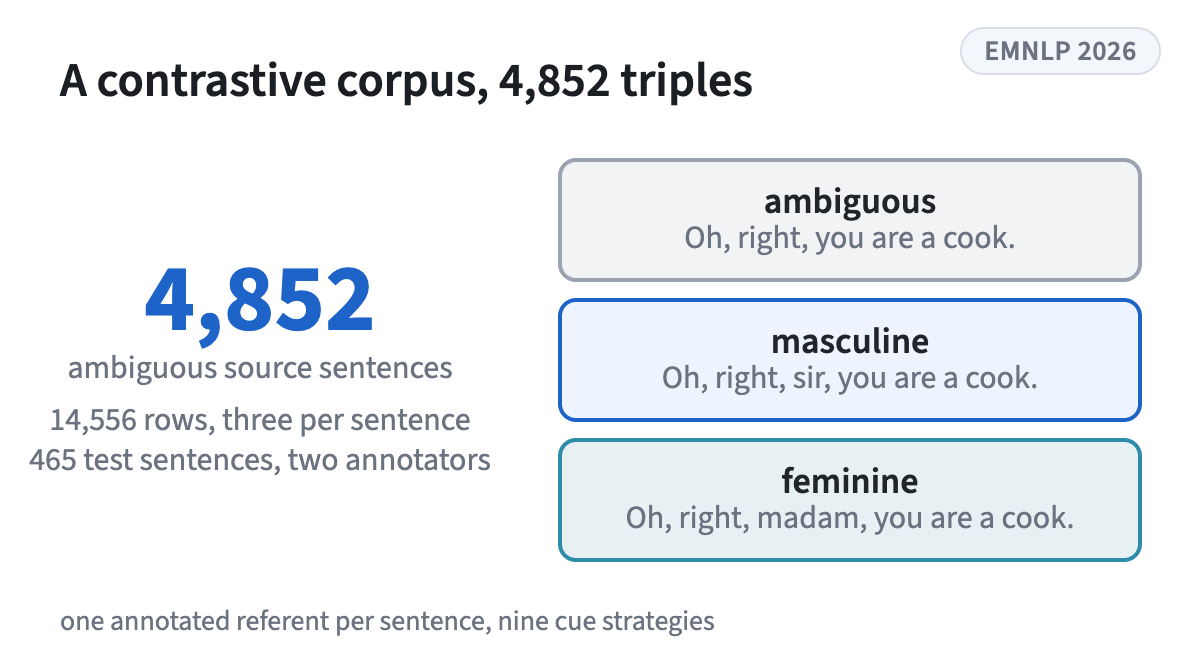
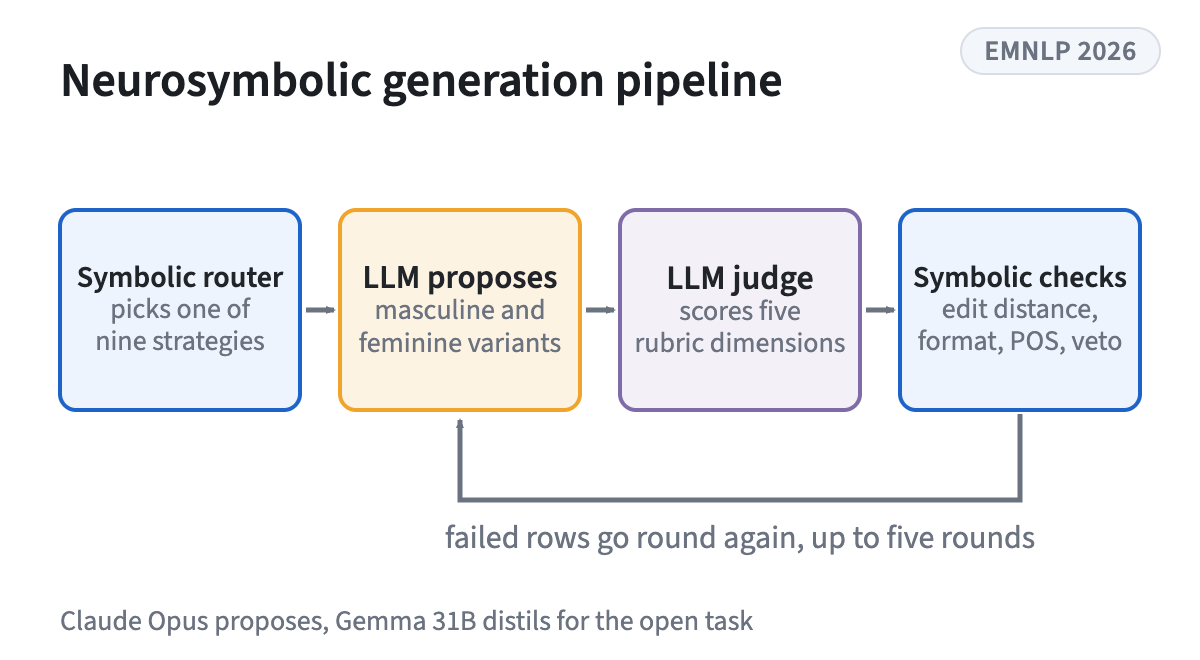
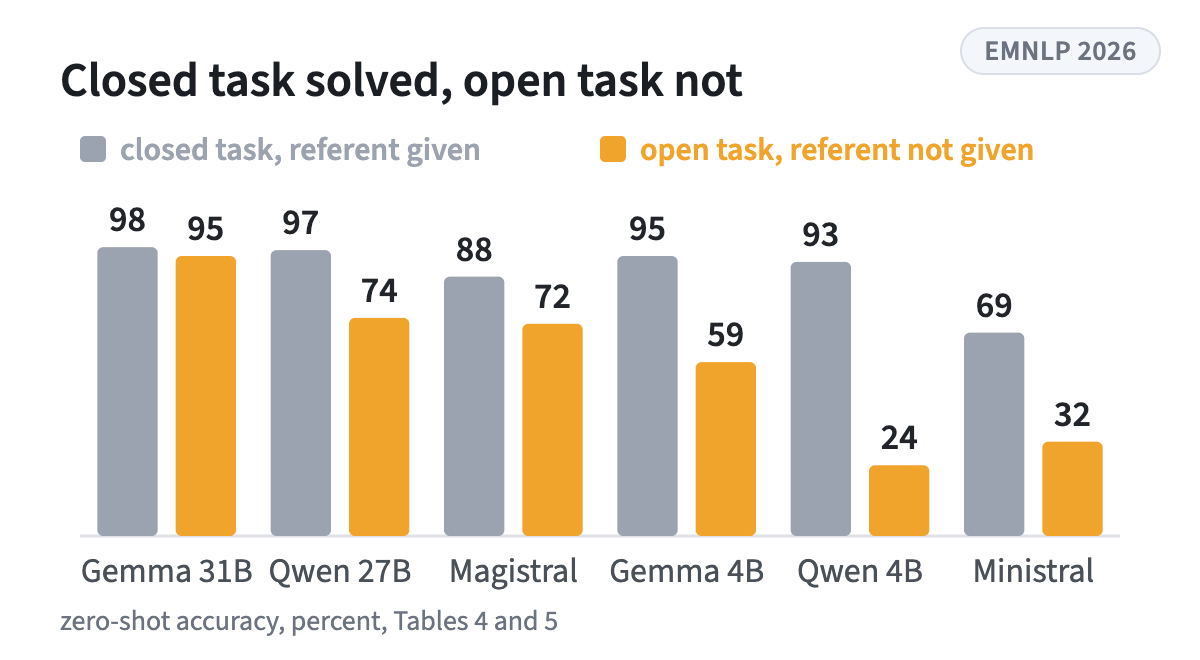
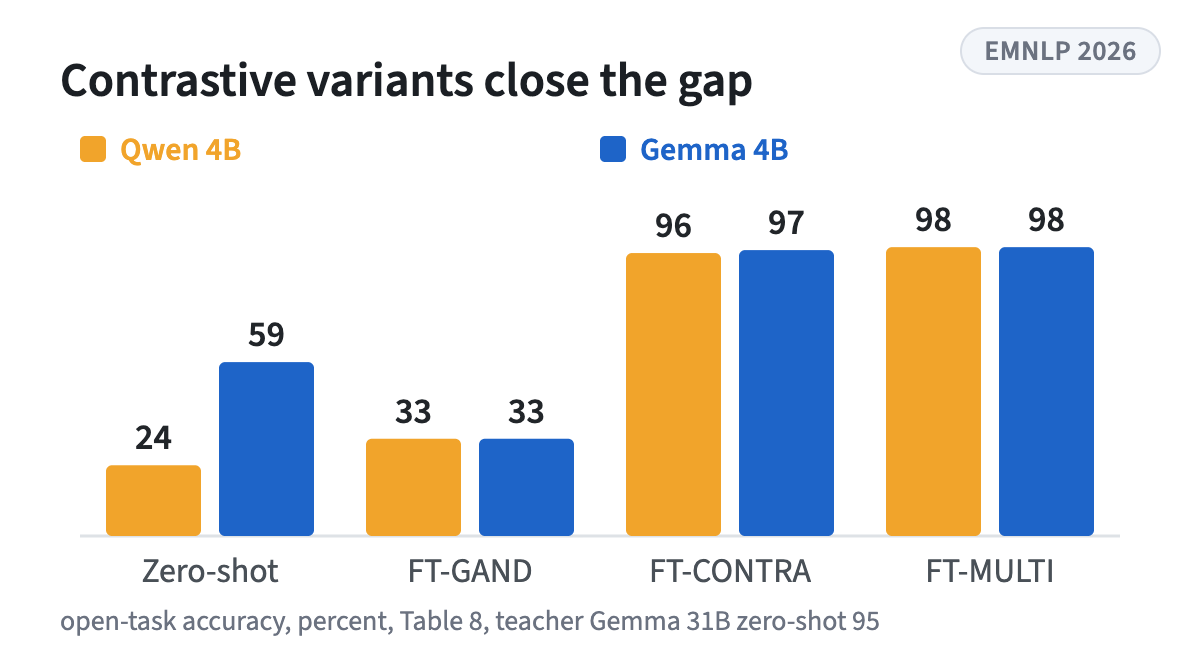
Gender-ambiguous sentences are where translation systems quietly pick a gender. ContraGAND is a contrastive corpus of 4,852 natural gender-ambiguous English sentences, each minimally paired with a masculine and a feminine variant generated by a neurosymbolic pipeline and audited by two annotators. We use it to evaluate gender ambiguity detection in six open-weight LLMs under two framings: a closed task where the referent is given, which current models solve, and an open task where the model must find the referent itself, which opens a gap that grows as models shrink. Two failure modes dominate, a binding failure where a cross-clause cue is not linked back to its referent, and a format failure where small models never produce a parseable answer. Both are over-prediction of the ambiguous class rather than stereotype-driven errors. Prompting and decoding fixes do not close the gap, but fine-tuning on the contrastive variants does, and distillation from a 31B teacher lets a 4B student match and pass it.
 PaperACL Anthology
 CodeGitHub
 DatasetHugging Face
 Model, closed taskHugging Face
 Model, open taskHugging Face
 DemoHugging Face Spaces
Research theme: Fairness in language models
Citation
@inproceedings{moerman2026contragand,
  author = {Moerman, Thomas and Gkovedarou, Eleni and Hackenbuchner,
    Janiça},
  publisher = {Association for Computational Linguistics},
  title = {ContraGAND: {Auditing} and {Repairing} {Gender} {Ambiguity}
    {Failures} in {LLMs} with {Neurosymbolic} {Contrastive} {Data}
    {Augmentation}},
  booktitle = {Proceedings of the 2026 Conference on Empirical Methods
    in Natural Language Processing (EMNLP)},
  pages = {11136-11159},
  date = {2026-10-26},
  url = {https://aclanthology.org/2026.emnlp-main.485/},
  langid = {en}
}